

Thinking back over the past couple of years, the best advice I was given was, ‘Stop doing so much. Say no sometimes.’
My instinctive response was, ‘But HOW?’ Not doing things or giving things up meant missing out on things I enjoyed. I repeatedly wondered out loud how other people ever had time to do anything, given that I never stopped and was still always a million steps behind where I wanted to be. And that was with never doing just one thing at once. Watching TV? I’m sorting paperwork at the same time. Having a shower? I’m cleaning the tiles simultaneously. Going out for the evening? Sure, let me just go to the gym and then we can go to this event and then this meetup and oh, we probably have time to grab a drink in the middle of that while we discuss that thing we’re working on right now.
I didn’t have time for myself. I didn’t have time to ‘be’, and I didn’t really understand why people would want to do that anyway. I’m still not convinced that the concepts of ‘doing nothing’ or ‘not thinking’ genuinely exist, but anyway.
Everything I did became a fight. Some of those fights were losing battles. Some of those fights were flat-out wars. It was a classic crash and burn cycle that I recognised but didn’t know how to fix. So I just kept going round in circles. What’s more is that not only was my circle of stuff not getting any smaller, it continued to snowball. For example, I started off a few years back by attending one local event a month – a tech meetup. Within a couple of years, I was attending five tech events, two gaming events (one of which I bake for), and a quiz every month, plus three separate yearly events, spin offs of the main monthly events, and the occasional national event…plus I recently added a volunteer charity baking job to that.
And all those events aren’t just events, because there are the people too. The organisers who personally ask me (and often Joe) to come, or speak, or help, or have a drink after, or whatever else. Don’t get me wrong, a lot of the people I meet through events are my favourite people. It’s important to the industry and the community that these events happen. I’m not complaining at all. I get as much out of it as I give, but there’s still only a finite amount of time. And the perks of networking mean that the more you get involved, the more you get pulled in, because there’s always someone who wants to meet you or get your advice or ask you to do a podcast.
And that’s just one fairly small segment of my life.
But these days, I feel like the stress monster is getting a lot smaller and insignificant, and it actually happened pretty quickly, and kind of by accident in a way. This is the story of how it happened.
1. Fixing the fundamental problem
This was my single biggest thing. No matter what else I tried to do, I felt like I was hitting a brick wall. I’d lose some weight then put it back on again. I’d make plans for my websites but not do anything with them. I’d plan to learn a new language and then stop after buying the books.
Nothing is more frustrating for me because I like to feel productive and that I’m getting somewhere. On top of that, I don’t give myself credit for the (many) things I do accomplish. I just look at the ever-growing pile of things left to do. So it seems obvious now that I ended up in a cycle of never feeling satisfied and never celebrating the achievements.
But the fundamental problem wasn’t any of these things; these were just side effects and casualties. My fundamental problem was a lot harder to solve, and took a lot of time. Most of that time was spent trying to identify and understand it, and I’m still not sure I did that particularly well. One of the hardest things I find about being an adult is that you have to make decisions where there is no simple path or obvious choice. So your fundamental problem (or problems) can be tricky to pinpoint. And even when you have pinpointed it/them, there’s no guarantee you’ll know how to fix it, or even want to fix it.
My advice is to figure out what your fundamental problem is by a process of deduction: What’s stopping you from achieving what you want to achieve? What do you complain about or get stressed out about the most?
And then:
How do you fix that?
It’s the fixing that’s the hardest part, and it will involve making a difficult decision – one that seems radical or that you’re unsure about. Change is tough. But you have to begin somewhere. And once you eliminate the biggest problem, everything else instantly becomes a lot easier to deal with and process.
2. Narrowing your focus
One of the classic components of mindfulness is just thinking about one thing at once, and narrowing that single train of thought down. I find this really hard because I’m a natural multi-tasker and flit between ideas and projects and lists across lots of different areas.
But there are only so many things you can focus on at one time without exploding altogether, and that’s even if worrying about x doesn’t compromise your ability to do y. If you like, it’s the whole cup thing.
I’ve found a couple of helpful ways to deal with that. Firstly, write a big list of whatever’s in your head that you feel is important. It could be recurring thoughts, problems, feelings, tasks, worries, whatever. Then set it aside and focus on one thing to think about right now. You don’t need to worry about forgetting the rest because it’s all written down, so you can clear it from your mind and free up some headspace. I find this part the hardest, because I’m hardwired to remember things and keep remembering them over and over in case I (or someone else) forgets.
So if I’m having trouble reducing thoughts down, I do a second thing: a task which takes my entire focus. My favourite option for this is photographing inanimate objects, because it’s perfect for centring your thoughts around one main thing – taking a great picture – without having worries or responsibilities for other people or animals. It’s a simple, achievable, productive task, so it ticks all the boxes for me. But anything that requires complete concentration will do the job.
3. Identifying and implementing solutions
I love being organised, but being so busy, I ended up with little piles of things (figuratively and literally) that I just ignored. As I dealt with one pile, each of the others continued to get bigger, and I continually spent my time maintaining the status quo rather than progressing. This ended up becoming a really big deal because it was a fundamental part of the crash and burn cycle, and was a source of endless frustration for me as I find it so important to feel like I’m moving forward.
I also didn’t have time to tackle the bigger mountains, because I was so busy dealing with the day-to-day. One example of this is our kitchen. It’s tiny and we have a ton of stuff that spills over into other rooms. It’s a horrible place to cook, it’s impossible to find things, and it’s not a place I enjoying spending time. For the past year or so I’ve sorted and resorted equipment and Tupperware and utensils and everything else without actually tackling the underlying problem: the entire thing needs ripping out and refitting. The bigger issue going unresolved just meant that the smaller problems kept coming back and needed to be dealt with again and again.
Now the kitchen is being dealt with, after some thought I identified other ‘zones’ around the house where we had a system that wasn’t working. The kitchen is by far the biggest example, but we also have smaller problem areas like drawers stuffed full of junk, post that’s constantly left forgotten, overflowing shoe and coat storage, etc. For each of these problem areas, I’ve taken the time to look at why they aren’t working, ideas for potentially fixing that, and turned them into recurring to do list items. It’s thrilling, I know. But it’s made such a difference already to actually get to the source of problems that I normally deal with in much broader, vaguer terms such as ‘I’m tired’ or ‘I’m anxious’.
I hate cleaning and tidying but I like having a clean, tidy house. The answer to this is to ditch the junk, be stricter about what we buy, buy more things that are multi-use, make sure everything has a place, keep on top of the problem zones, and get a cleaner to delegate the majority of weekly tasks to. All these things require more organising (and therefore more stress) to start with, but will hopefully lead to fewer problems in the future.
Another thing that’s helped massively is adopting a ‘touch it once’ rule. We’re still working on getting it right, but basically it revolves around dealing with something in one go rather than dumping it somewhere to come back to. So if post is picked up from the floor, it gets opened and sorted straight away. If a plate is taken to the kitchen, it’s washed up rather than being left on the side. It works really well when I don’t get lazy about it, but again fixing the main underlying issues will help make that much easier.
Again, it comes down to having fewer things to think about and deal with.
4. Compartmentalising and to do lists
One of the best ways to narrow focus, keep organised, and implement solutions is to create effective to do lists. At least for me, because I LOVE lists. I’ve tried so many different things for creating lists and managing time and projects: Wunderlist, Trello, Project Pier, Slack, even good old-fashioned paper. But I’ve found that the best option is Todoist. I love that I can set recurring tasks and keep everything super organised, and colour code and create sub-projects/tasks and stuff.
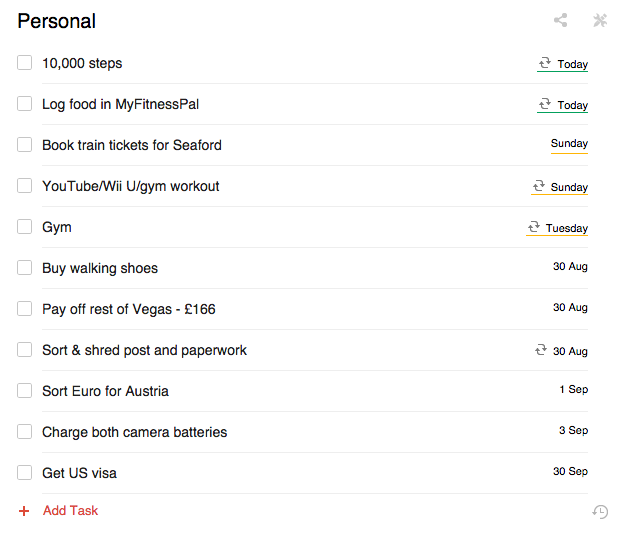
Todoist takes care of everything from grocery shopping to blogging schedules to paperwork sorting, and then I also have a physical diary to note events and appointments in (I might start using a calendar app at some point, who knows). My day job stuff is organised separately through Trello, Slack, and RescueTime, which is probably a blog post in itself.
I found that my main problem with lists was that I would add something and then either forget about it or do a burst of tasks in a productive moment and then forget about them again. I then got stressed when my lists were too long, or annoyed at the time I spent making lists for them to just become irrelevant. Using Todoist, I have weekly, monthly and quarterly tasks and lists set up as needed, so they stay relevant on their own, I don’t need to remember to re-add stuff, and today’s and this week’s tasks are automatically given their own list so I actually remember to do things. It’s a huge time saver.
5. Sleeping
It’s rare that I have problems going to sleep or staying asleep (unless there are cats involved), but it’s very easy for me to wake up just as tired – if not more tired – than when I went to bed, even after a good night’s sleep. I found that clearing my mind more, both of things to do and problems, ensured that my sleep was a lot more restful and helpful. I’ve also found that I need more sleep; bedtime has crept back over the years and I tend to go to bed around midnight and get up at seven. At weekends I usually go to bed much later but still wake up at the same time, which leads to a sleep deficit that grows slowly over weeks and months until I start to up the caffeine and notice I’m getting more stressed and tired. I tracked my sleep for a while using Fitbit, but I hate sleeping with anything on my wrists or hands, so I might see if I can overcome that hate and start tracking better. But even if I don’t, being aware of it helps. Getting tasks done more efficiently leaves more time for relaxing and sleeping – I just need to make sure that happens.
6. Exercise
As with anything else, exercise for me was something that I’d be madly obsessed with for a few weeks and then it would disappear from my life altogether as something else occupied my time. Again, I needed to break the crash and burn cycle. I’m still working on getting this right, but I’ve made progress by setting a standard goal for myself every day – 10,000 steps – and then adding weekly goals around that, such as gym visits or YouTube workouts. Before I’d do 8,000 steps one day and 15,000 another, and I’d do a 12k at the gym or not end up going.
The summary bit
I’ve rambled on a lot, but I have so much happy mental energy at the moment and I finally feel like I have a solution to most of the problems I’ve been struggling with for so long. I want to build on what I have to create an efficient routine that gives me structure and enough time to do what I want to do, minimise the essential but unenjoyable tasks, and above all, achieve my goals.
It was essential for me that I dealt with the problems and the stress without compromising on who I am or what I like about my life. It’s important to me to give 100%, and it’s important to me to do things well. I would rather something be done properly or not at all, and I want that aspect to stay. But I also know that I can’t give my best if I’m spread too thinly, and that optimising my time is the best chance I have to be able to keep saying yes and avoid wasting energy on the little things.
What tips and tricks do you have to stay organised?


No Comments